> For the complete documentation index, see [llms.txt](https://postman-v2.guides.gov.sg/llms.txt). Markdown versions of documentation pages are available by appending `.md` to page URLs; this page is available as [Markdown](https://postman-v2.guides.gov.sg/postman-v2-admin-portal-for-ui-users-internal/how-do-i-onboard-postman-v2-internal-sms/1.-sender-id-registration.md).
# 1. Sender ID Registration
Note: for internal-facing SMSes only.
Now that you've decided to use Postman for your internal SMS campaigns, first ensure your desired Sender ID is registered under the Full SSIR Regime.
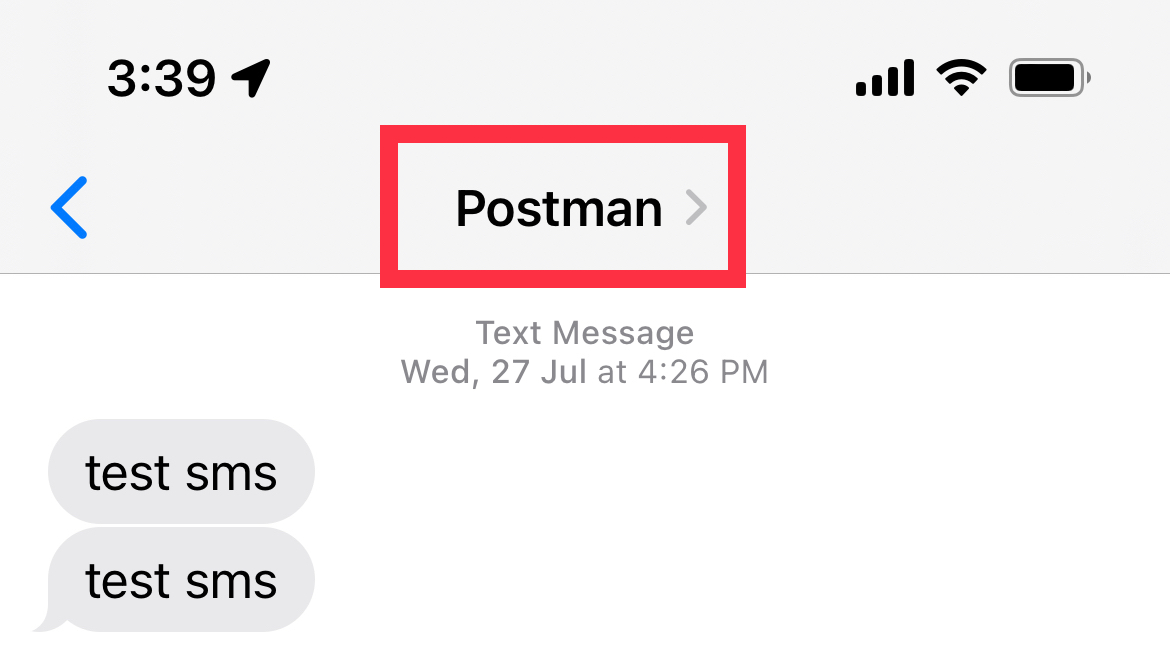
As part of national scam prevention efforts to filter out non-legitimate SMSes to citizens, IMDA has necessitated the registration of SMS Sender IDs for all organisations in Singapore on the SMS Sender ID Registry (SSIR), including public agencies, from 31 January 2023. You can read more about this new policy [here](https://www.imda.gov.sg/Content-and-News/Press-Releases-and-Speeches/Press-Releases/2022/Full-SMS-Sender-ID-Registration-to-be-required-by-January-2023). The Sender ID refers to the name that you see at the top of an SMS sent to you by an officially-registered organisation.
Some large agencies might already have registered their Sender IDs. This is especially the case for generic agency-name Sender IDs like `MSF` or `MTI`. If you are unsure if the Sender ID you would like to use has already been registered by your agency, please do check internally before submitting your registration.
#### **How do I register for a Sender ID?**
You will need to register via the SSIR portal [here](https://smsregistry.sg/web/login). Approval will take a few days as the Singapore Network Information Centre (SGNIC) - a wholly-owned subsidiary of IMDA - will need to conduct specific name and homoglyphic checks on your desired Sender ID. More information on Sender IDs and fees imposed by IMDA [here](https://www.sgnic.sg/faq/sms-sender-id-registry).
---
# Agent Instructions
This documentation is published with GitBook. GitBook is the documentation platform designed so that both humans and AI agents can read, navigate, and reason over technical content effectively. Learn more at gitbook.com.
## Querying This Documentation
If you need additional information that is not directly available in this page, you can query the documentation by asking a question.
Perform an HTTP GET request on the following URL with the `ask` and `goal` query parameters:
```
GET https://postman-v2.guides.gov.sg/postman-v2-admin-portal-for-ui-users-internal/how-do-i-onboard-postman-v2-internal-sms/1.-sender-id-registration.md?ask=&goal=
```
`ask` is the immediate question: it should be specific, self-contained, and written in natural language.
`goal` is what the user is ultimately trying to achieve, the reason they need the answer. Sharing it helps GitBook give you a better, more relevant answer. A goal is most helpful when it describes the outcome the user wants rather than restating the question. For example, with `ask=how do I create an API token`, a goal like `automate deployments from our CI pipeline` lets GitBook tailor the answer to that use case.
The response will contain a direct answer to the question and relevant excerpts and sources from the documentation.
Use this mechanism when the answer is not explicitly present in the current page, you need clarification or additional context, or you want to retrieve related documentation sections.