> For the complete documentation index, see [llms.txt](https://postman-v2.guides.gov.sg/llms.txt). Markdown versions of documentation pages are available by appending `.md` to page URLs; this page is available as [Markdown](https://postman-v2.guides.gov.sg/postman-v2-general-user-guide-mop/create-campaign/character-count.md).
# Character count
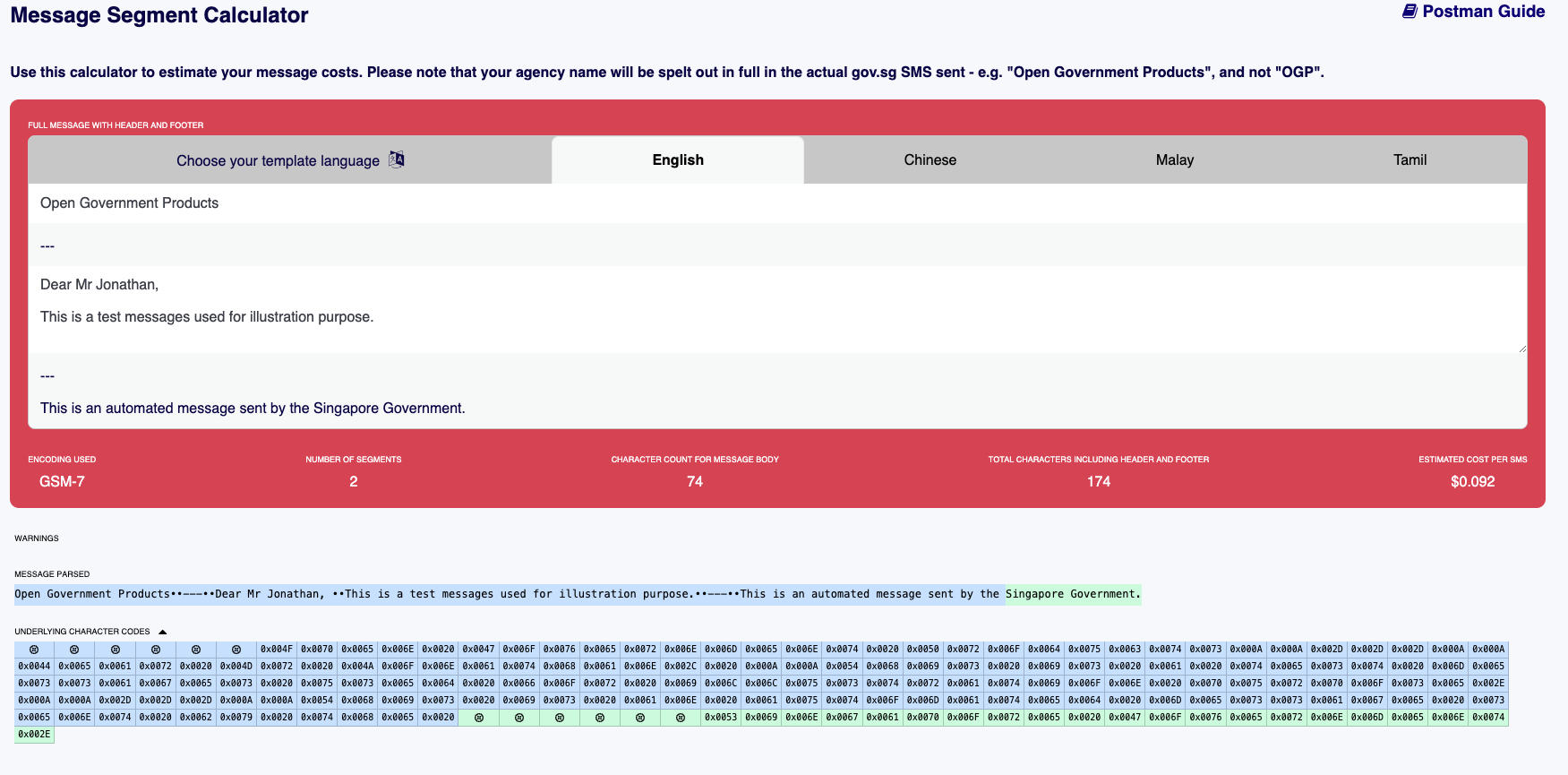
Visit https\://message-segment-calculator.postman.gov.sg for message segment and character counts
Postman allows a maximum of 1000 characters for a message body, excluding the header (agency’s name) and footer.
Agencies are strongly encouraged to limit their message body to **320 characters** (excluding the header and footer) to avoid potential delays with message deliverability. As a precautionary measure, a warning message will appear for messages beyond 320 characters.
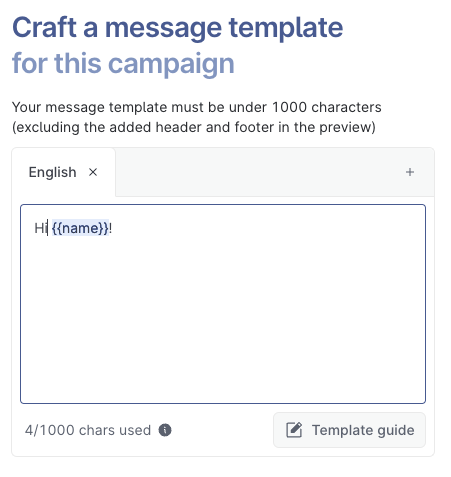
If the message body exceeds 1000 characters, the system will disable the ability to send the message. Message parameters, such as {{variable}} are not counted as characters. However, when these parameters are populated with actual values, the character count of the populated value is added to the overall character count.
For example:
* Message variable placeholder {{name}} is not included in the character count when crafting the message template.
* Filling the {{name}} variable with “**Jonathan**” adds 8 characters to the count
Visit [https://message-segment-calculator.postman.gov.sg](https://message-segment-calculator.postman.gov.sg/) to use the Postman Message Segment Calculator tool to count your total characters.
### Use the Message Segment Tool before sending messages
#### Characters - English Language
The characters in a single text message include the following for "English" language\*, with additional formatting details:
* **Header**: Free text field in message segment tool to type your agency name
* **Line breaker**: use normal keyboard paragraphing to indicate line breaks. **Do not use `\n` as `\` will be blocked by Postman.**
* **Slash icon** ( --- ): 3 characters to separate sections
* **Body**: Free text field for your message content
* **Line breaker**: use normal keyboard paragraphing to indicate line breaks. **Do not use `\n` as `\` will be blocked by Postman.**
* **Slash icon** ( --- ): 3 characters to separate sections
* **Footer**: 62 characters\* for standardised "English" text used across all WOG messages
\*Do note that the character count is different for other languages such as Chinese and Tamil.
#### Encoding used for English language
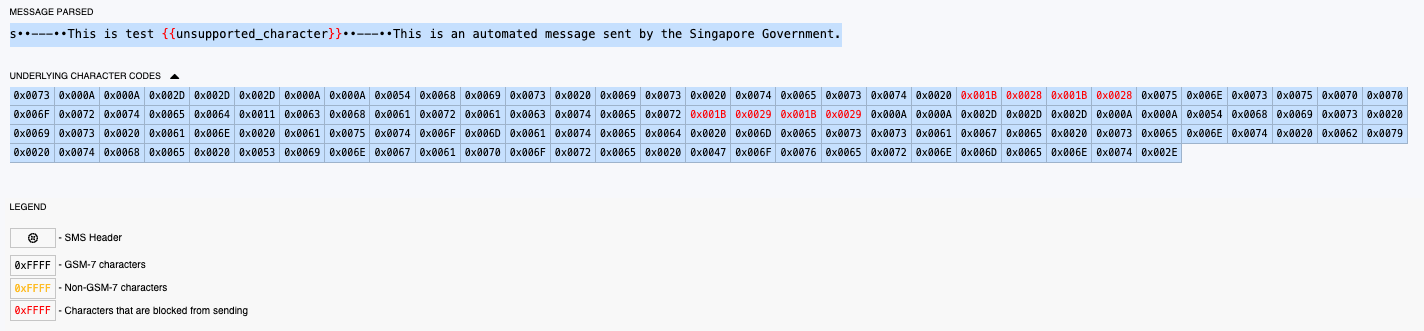
The encoding used for Postman SMS messages is **GSM-7** or **UCS (Unicode)**. Postman will not be able to send messages that contain [unsupported characters](https://postman-v2.guides.gov.sg/postman-v2-general-user-guide-mop/create-campaign/message-content#unsupported-characters), and a warning message will appear below the calculator for using invalid characters.
Enter your message template into the message segment tool to identify characters that are classified as GSM-7, non-GSM-7 and blocked characters in the "Underlying character codes" section.
#### Encoding used for English language
The encoding used for other languages (Chinese and Tamil) is **Unicode**, where both the footer contains either Chinese or Tamil characters.
#### Number of segment
A message segment refers to a portion of a text message when the total length exceeds 160 **GSM-7** characters. If a single message is longer than 160 characters (including header and footer), it is divided into multiple segments. Each segment contains up to 160 GSM characters, including the header and footer. However, when a message uses more than one segment, the character limit per segment is **reduced to 153 characters**.
If the text message contains a **Unicode** encoding character, the maximum character count for one segment is 70 characters. If the Unicode message is longer than 70 characters (including header and footer), the character limit per segment is reduced to **67 characters**.
* Understand more about [message segment](https://docs.developer.tech.gov.sg/docs/postman-sgdp-guide/sms-terminology) terminology
You will be able to view how the message is broken up to multiple segments (as shown below) in “Message Parsed” and “Underlying Character Codes”, based on the character count, and this ensures that the character limits for each segment are properly managed.
Blue blocks are considered as 1 segment and green blocks are considered as another segment
#### Character count for message body
The character count applies only to the content typed in the free text box for the message template. The maximum number of characters Postman allows is 1000, excluding header and footer.
#### Total characters including header and footer
The total character count includes the entire messages including the agency name as the header, the body of the message and the standardised government text as the footer.
#### Estimated cost per SMS
Use the message segment tool to estimate the cost for your SMS message. Do note that the cost is based on message segment which include header, body and footer. Refer to the [policy guide](https://docs.developer.tech.gov.sg/docs/postman-sgdp-guide/sms-charges-pricing) on SMS charges and pricing.
---
# Agent Instructions
This documentation is published with GitBook. GitBook is the documentation platform designed so that both humans and AI agents can read, navigate, and reason over technical content effectively. Learn more at gitbook.com.
## Querying This Documentation
If you need additional information that is not directly available in this page, you can query the documentation by asking a question.
Perform an HTTP GET request on the following URL with the `ask` and `goal` query parameters:
```
GET https://postman-v2.guides.gov.sg/postman-v2-general-user-guide-mop/create-campaign/character-count.md?ask=&goal=
```
`ask` is the immediate question: it should be specific, self-contained, and written in natural language.
`goal` is what the user is ultimately trying to achieve, the reason they need the answer. Sharing it helps GitBook give you a better, more relevant answer. A goal is most helpful when it describes the outcome the user wants rather than restating the question. For example, with `ask=how do I create an API token`, a goal like `automate deployments from our CI pipeline` lets GitBook tailor the answer to that use case.
The response will contain a direct answer to the question and relevant excerpts and sources from the documentation.
Use this mechanism when the answer is not explicitly present in the current page, you need clarification or additional context, or you want to retrieve related documentation sections.